So, here's why I haven't read many books so far this year: Because I've read fifteen volumes of Schlock Mercenary, a web comic turned graphic novel. Did I like it? Well, I'm on my fifteenth volume, so there you go.

In the very first strip Schlock joins, as you might expect, a group of space mercenaries called Tagon's Toughs. To paraphrase the old A-Team opening, if you've got the money--and if you can find them--you can hire Captain Kaff Tagon's army-for profit. But you won't have any trouble finding them, because they leave disaster in their wake.


 Schlock, one of the few known carbosilicate amorphs in the galaxy, looks like nothing so much as a big pile of poo, and is very close to indestructible. He approaches his job with glee and loves nothing so much as dismantling anything and anyone he gets aimed at. When bad guys stand in his way, they usually end up blasted or eaten.


Meanwhile, the rest of Tagon's Toughs range from humans, to aliens of every type, to Earth animals who gained sentience. The company's biggest antagonists are also its biggest allies: Artificial Intelligences running ships and worlds, which communicate through avatars that mostly look like humans (although one resembles a super-cute koala).

Writer and artist Howard Taylor covers modern problems ranging from politicians to nanobots, using parody, satire, and just plain laugh-out-loud humor to deal with a violent universe that's always on the edge of blowing up--sometimes literally.


Taylor himself admits to being weak on the artistic side when he first started out. But the art gets better, and the writing is on the money right from the get-go. He happily tackles just about every science fiction concept ever invented, hard and soft, and as the series goes on the challenges and players get bigger and bigger. Taylor's not afraid to kill off characters, and those that eventually come back do so in a convincing way--or at least, a way that may be possible in the future. It's clear the author has a good grasp on technology, even if he happily strays from known science for a story or a laugh.

Meanwhile--and this might be the most surprising part of Schlock Mercenary--Taylor gives us relatable, engaging characters along with the well-plotted stories. As the scale gets bigger and bigger, the characters change and grow and, as mentioned earlier, the art gets better.

Check out the strip or order the books here:

https://www.schlockmercenary.com/

You can click on "Schlock Mercenary Begins", which will take you to a redone version of the first strip, and below that is a link to the original strip. Did I mention the art gets better? It does.


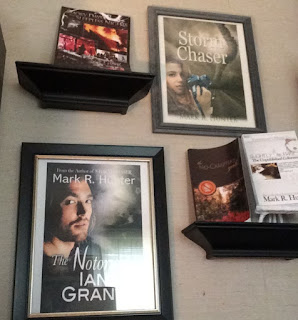
 And my stuff is here:


 Remember: Reading keeps you from turning into a big pile of poo.


 Okay, so check this out: As I'm sure all of you remember, back in 2021 I had a short story, "Everybody Knows Your Name", published in East Of the Web, an online fiction magazine. The original short story is here:

http://www.eastoftheweb.com/short-stories/UBooks/EverKnow1183.shtml


And the post I made about it is here:

https://markrhunter.blogspot.com/2021/01/new-short-story-everybody-knows-your.html

Not that you need to read the blog post, but I try to be thorough. Anyway, the story has been translated and republished ... in Romanian.

It has TOO. I have proof:

https://fictiuni.ro/toti-iti-stiu-numele-mark-r-hunter/


Amazingly, my name in Romanian is the same as my name in English.


 Ha! Told you. The Senior Editor, a very nice man named Nicu Gecse, asked if I would allow the story on fictiuni.ro for their tenth anniversary issue. As you might imagined, I checked to make sure it's the real deal, and it is--they've even published an Isaac Asimov story.


"Everyone Knows Your Name" is the story of a time traveler whose first trip--as tends to happen with time travelers--doesn't go at all the way he planned. I love time travel stories, and I tried to make this one original, and ... maybe I succeeded. If not, I'll just go back to 1955 and try again.

So you people taking Romanian to get that language minor, here you go--enjoy! Of course, the story won't be a true classic until it's translated into Klingon.


Remember, if you ever go time traveling, take a good translation book with you.


 Five teens who otherwise have little in common bond over a shared tragedy: Five years earlier a steel mill exploded in Splendor, Ohio, leaving the surviving townspeople grieving.

Now Franny and her brother Arthur join Sofia, Remy, Levi, and Nick in filming a mockumentary web series they call "Ghost Hunters". It's all for fun and distraction--until they witness the crash of a disk-shaped object that engulfs them in light ... and gives them supernatural powers.


https://www.amazon.com/When-Fell-Splendor-Emily-Henry-ebook/dp/B07DT5VWD9


Soon they're being chased by the government, threatened by the recluse accused of causing the steel mill accident, and discovering their unusual abilities are anything but a gift. Their attempts to solve the mystery and escape detection make up the plot, but the heart of the story is with the teens, as they try to deal with their grief and sense of loss from an all too natural tragedy.

 Emily Henry's 2019 novel manages to balance the two, giving us real characters adjusting to an unreal situation that may include Franny being possessed by an alien. There's plenty of action and some twists I didn't see coming, but I was most impressed with Henry's ability to portray her damaged teenage characters. I noticed there was a high school activity book related to the novel, so it appears I wasn't the only one struck by her grasp of story and characters.

It's certainly worth giving Emily Henry's other books a look.


Remember, authors who don't get enough reviews often get abducted by published aliens.


 The Earth is dying. Isn't it always, in today's YA dystopian novels?

The government has hatched a Hail Mary plan: They'll send small teams to various planets, to investigate whether those worlds can be used to resettle the human race. 17-year-old Matthew, in return for money to save his sick mother, agrees to join one of those teams for the Exo Project. It's pretty much a death sentence, since most will awaken a century later to planets that can't support life.

But Mathew's team gets lucky: They land on a world with a breathable atmosphere and life. Oh, and intelligent alien beings who are less than eager to find their home invaded. At least, not all of them are.

https://www.amazon.com/Exo-Project-Andrew-DeYoung/dp/1629796107


Kiva is the young girl who's just been picked to lead the matriarchal society of her people. She also has dreams, and she's seen Mathew's ship coming. While she tries to investigate the newcomers and keep peace between them, others on both side are determined to sabotage her efforts. It doesn't help that Kiva, as leader, cannot marry or have any romantic relationship, and you can just guess how that will go.

But while romantic complications might be inevitable in this YA science fiction, there are plenty of surprises to come in Andrew DeYoung's fast-paced exploration of culture clash. It turns out there are dark secrets behind both The Exo Project and Kiva's people, secrets threatening to destroy everything.

Certainly there are echos of Earth history in The Echo Project, but Andrew DeYoung mixes it up pretty well, giving us a rich culture on the alien planet as well as well-rounded characters on both sides. It's a fun read, and I'd recommend trying both this book and anything else Andrew DeYoung has written.


Remember: Even space travelers need a good book or three.


 When a novel begins with the total destruction of Earth and everyone on it ... where do you go from there?

In God's Bolt, Ron Forsythe goes to the only survivor: scientist Helen Southcote. Alone on a United Nations sponsored space station, she has to witness the asteroid impact that destroys the world, and live with the knowledge that she's the only survivor.

She doesn't handle it well.

Helen's only companion is an Artificial Intelligence running the station that she doesn't really like, and her only comfort the knowledge that the search for intelligence elsewhere, her life's obsession, was successful: There is life out in the rest of the galaxy. Unfortunately, it's so far away that it's no hope of rescue, and unlikely to even know of the Earth's destruction.

 God's Bolt by [Ron Forsythe] 

 https://www.amazon.com/Gods-Bolt-Ron-Forsythe-ebook/dp/B07QB9CFJL


For the rest of the novel Forsythe flashes back to Helen's life, the creation of the space station's A.I., and the discovery of the massive asteroid that sneaks up on Earth, along with efforts to divert it. At the same time we follow Helen's recovery from despair. She's seen her friends and family all die, and is now stranded on a space station that can never land. The best she can hope for is to survive, alone, and watch the world burn beneath her.

Not the most upbeat life in the world. Still, God's Bolt is fascinating in the same way so many disaster stories are, even if the "Who will live?" question seems settled right from the beginning. The writing can be repetitive at times, especially when it comes to Helen's breakdown and the fight against the asteroid--I couldn't help thinking it wasn't necessary to say it was huge so many times, for instance. But it was an interesting, optimistic, look at what the world could be in a century and a half or so. Interesting enough that I was sad to see it go!

Helen is the main viewpoint character in God's Bolt, and I found her well rounded, especially as we get to follow her through her life and dedication to the search for extraterrestrial intelligence. That's a subject I assumed was an unnecessary side story, but just about everything is tied up at the end.

I also found the efforts to stop the disaster, complete with infighting in the world's government and the rise of a doomsday cult, to be fascinating, even knowing their efforts would ultimately fail. All in all a fun read, or at least as fun as planetary Armageddon can be.

By the way, improbably ... there's a sequel.

https://m.media-amazon.com/images/I/51ulBV0gGyL._SY346_.jpg


http://markrhunter.com/
https://www.amazon.com/-/e/B0058CL6OO
https://www.barnesandnoble.com/s/"Mark R Hunter"


Writing instructors, editors, publishers, they all say the same thing: When writing a piece of fiction, start at the beginning; go to the end; then stop.

Don't pad it. Don't be too sparse. Just make your story as long as it needs to be, no longer. It's good advice.

It's also wrong.


What do these works have in common? That's right: They're too short.

 
I got lucky with my early books, because my publishers weren't that picky about word count. My novels tended to weight in at around 55,000 words, which sounds like a lot, but it's at the lower edge for fiction. The first science fiction novel I tried to sell clocked in at around 62,000 words. I reevaluated it, added some new and expanded scenes, and got it up to 68,000. That was it. The whole story.
 
Now, Fahrenheit 451 by Ray Bradbury is only 46,000 words long ... but that's Ray Bradbury. Stephen King wrote The Stand, which is half a million words and thus far over the norm for any book. But he's frakking Stephen King. Believe me, a new author will get nowhere by whining that, well, George R.R. Martin and J.K. Rowling write long!
 
"When millions of people know you by your initials, get back to us." 
 
Many publishers won't even glance at your work if you don't go through a literary agent, so although they aren't strictly necessary, they can be great door openers. But after Beowulf: In Harm's Way got several rejections, one agent decided to level with me:
 
"I'm afraid this isn't right for me, but beyond that I'm also concerned that your word count of 68,000 is on the low end for Science Fiction."


What ... this is it? Did you consider putting in more dog scenes?"

 According to my research, people in publishing think the right word count for a science fiction novel is around 80-120,000 words. It varies for other genres: For instance, romance novels can commonly be as low as 50-55,000 words, which is how I got away with my romantic comedies. But it's possible some of the agent rejections for Beowulf: In Harm's Way were as much because of its length as anything else.

This really rubbed me the wrong way. We get lectured over and over: Never pad your story! It should be as long as it needs to be, and no more! Cut the fat! So if the story is perfect at 68,000 words ... what the heck?

I struggled with this for some time: If I wanted my story to come out at the low end of the proper length, I'd have to add at least 12,000 words. Of course, I could self publish it at whatever length I wanted, but I really wanted this story to have a chance with a big publisher, and even be the beginning of a series. But ... 12,000 words ...

Luckily, a solution was already right there, on my hard drive.

"Check this out: I'm putting in a prologue! That'll show 'em."

When my first novel, Storm Chaser, was picked up by a publisher, I thought it would be fun to promote it by writing short stories about the characters, to give away as a way to get readers interested. My publisher jumped on that, and the collected stories became my second book, the collection Storm Chaser Shorts. I liked writing about the characters so much that I'd already decided to do the same with Beowulf: In  Harm's Way. In fact, I'd already written five short stories in that universe.

Three of them were fun but silly little pieces that I didn't feel belonged in the novel's narrative. The other two were longer, and took place at the beginning of the story. They became chapters one and two, and I wrote a prologue that led right into them. (Prologues are another controversy. I like 'em, if they have a point.) By the time I'd added some connective material and looked through the manuscript for thin areas that could be expanded ...

Ta Da! 84,000 words, and none of it padding. I don't think.

I can't really complain, because after I put it all together, revised, polished, and read it again ... the manuscript was better than the shorter version. (Well, I think so. What do I know? I should ask some beta readers to check it out.)

How do you feel about word counts? Do you care, or is a long book intimidating, or does a short one seem too lightweight? It seems strange to me that novels seem to be getting longer, even as potential readers are accused of having shorter attention spans.


This one is a bit odd for me, considering The Flying Girl was published all the way back in 1911. Still, it came highly recommended, and I found it easier to read than a lot of other writing at the time was.

It's also far more feminist than you'd imagine, at least for its time. The Flying Girl tells the story of Orissa Kane, a 17-year-old in California who's holding down a job to support her blind mother and her brother, an inventor who's working on his own flying machine. To say airplanes were still new at the time puts it mildly; in fact, the author gives credit for help on the book from Glenn C Curtis, a founder of the U.S. aircraft industry and winner of the first international air meet, and Wilbur Wright, who with his brother did something even more spectacular just eight years before publication.

Orissa's brother Steve is a genius in mechanical design, but the Kane family finds itself in the middle of a dispute with two former business partners, who want to invest in the Kane airplane for different reasons. Here Van Dyne cleverly describes one partner in heroic terms and the other like one might describe a silent movie villain--then flips the script.


 Soon the plane is the target of sabotage that injures Steve; and although it can be repaired, Steve is forced out of an upcoming nationwide competition by a broken leg. If only there was someone who'd been watching over his shoulder the whole time, and knew just about as much about the flying machine as Steve himself ... but who ...?

Oh, no, surely not a girl. How indecent!

To say the book's approach to a female protagonist was advanced for the time is putting it mildly. Orissa Kane jumps into the role of airplane pilot fearlessly, and meets all the many challenges that come along with it. Yes, there's a boy, and Orissa never loses her "maidenly virtues", but she's also competent and way braver than I would have been.

But what would you expect, from the same author who invented Dorothy Gale and Ozma of Oz?

Because Edith Van Dyne was really L. Frank Baum, who wrote The Wonderful Wizard of Oz and its sequels. That shouldn't come as a surprise for those who read the Oz books, which were full of strong, smart, competent female characters. (And it's how The Flying Girl came into my reading orbit. I've been reading up on Baum as I prepared to tackle writing my own Oz book.)

By today's standards The Flying Girl would be considered a young adult book, and it also works pretty well, a century later, as an historical novel. In context it's surprisingly advanced not only in its treatment of women, but in its technical aspects--it turns out Baum, who wrote science fiction and invented an early robot and miniature submarines, had an interest in the mechanical.

There's a sequel, The Flying Girl and Her Chum, and I liked this one enough to look forward to trying the second one.

 https://www.gutenberg.org/files/53386/53386-h/53386-h.htm

 https://www.amazon.com/gp/product/1929527241


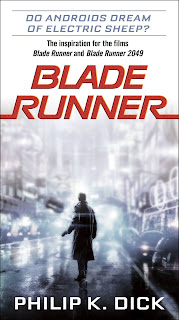
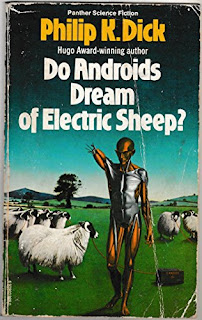
Rikk Deckard is a bounty hunter in a futuristic city, who flies his hover car around while on the hunt for escaped androids who need to be "retired".

Gosh, that sounds an awfully lot like the plot of the movie "Blade Runner", doesn't it?

"Do Androids Dream of Electric Sheep?", by Philip K. Dick, was first published in 1968, and was indeed the inspiration for the 1982 film of the different name. The setting was moved for the movie from the post-nuclear war San Francisco of 1992 (later changed to the really far future: 2021) to an almost as dystopian Los Angeles of 2019, and where the hell is my flying car?!

Ahem. I can just imagine police having to investigate those accidents.


Deckard is given the task of hunting down six androids of a new model, practically indistinguishable from humans, and he has a very good reason for finding them: Each is worth a bounty of a thousand dollars, and with that kind of money he and his wife can trade in their electric sheep for a real, living, expensive animal--maybe even a goat.

Yeah, you heard that right. In the aftermath of a nuclear war most humans have migrated offworld (and each migrant is given their own android), while those who remain behind find animals so scarce that they're sold like some kind of gold plated work of art. The problem is, some androids rebel, kill their owners, and smuggle their way back to Earth, where police employ bounty hunters to find them.

Meanwhile, a secondary plot covers John Isidore, a man whose low IQ kept him from migrating, who finds himself helping the escaped androids. As Deckard goes through his list and gets closer to a final showdown, he's increasingly exhausted, and also begins to question the morality of his job. Deckard also discovers the six androids he's after may be only the tip of the electronic iceberg.

There's also a subplot involving Mercerism, a technology based religion that's, frankly, weird. But Mercerism becomes a factor when Deckard closes in on the last three androids and the hapless Isidore.


For those of you who watched the movie, yes, Rachael Rosen is there. Otherwise there aren't enough similarities between the book and the movie for me to really say one is better than the other--but they're both sufficiently bleak and downbeat to make a person want to drown in a bottle of Jack Daniels. Just the same, the author Philip K. Dick (no relation to Philip J. Fry) was great at characterization, and at setting the stage for his fictional worlds. It's a fascinating read and worth trying, although the final conflict and the ending both seem abrupt.


http://markrhunter.com/
https://www.amazon.com/-/e/B0058CL6OO
https://www.barnesandnoble.com/s/"Mark R Hunter"

 My science fiction short story, "Everybody Knows Your Name", is available to read on the East Of the Web website:

http://www.eastoftheweb.com/short-stories/UBooks/EverKnow1183.shtml

It's about a scientist whose invention doesn't cause the problems most people think of ... instead, he finds an entirely new worry.

Remarkably, it only took about a week from the time they accepted this story until it came out. My last published short story took four months from acceptance to publication! But in that case there was also a print version of the magazine, while East Of the Web is e-pub only.

Let me know if you like it! Don't let me know if you don't like it. Yeah, I can take it, but I don't want to.


http://www.eastoftheweb.com/short-stories/UBooks/Covers/c_EverKnow1183_ip_cov.jpg


Remember, if you like a short story, it gets a chance to grow up and become a real boy.
 
Sometimes I think my wife and I are the kiss of death to TV shows. Whenever we really get into a new one--canceled. (Don't get me started on "Emergence".)

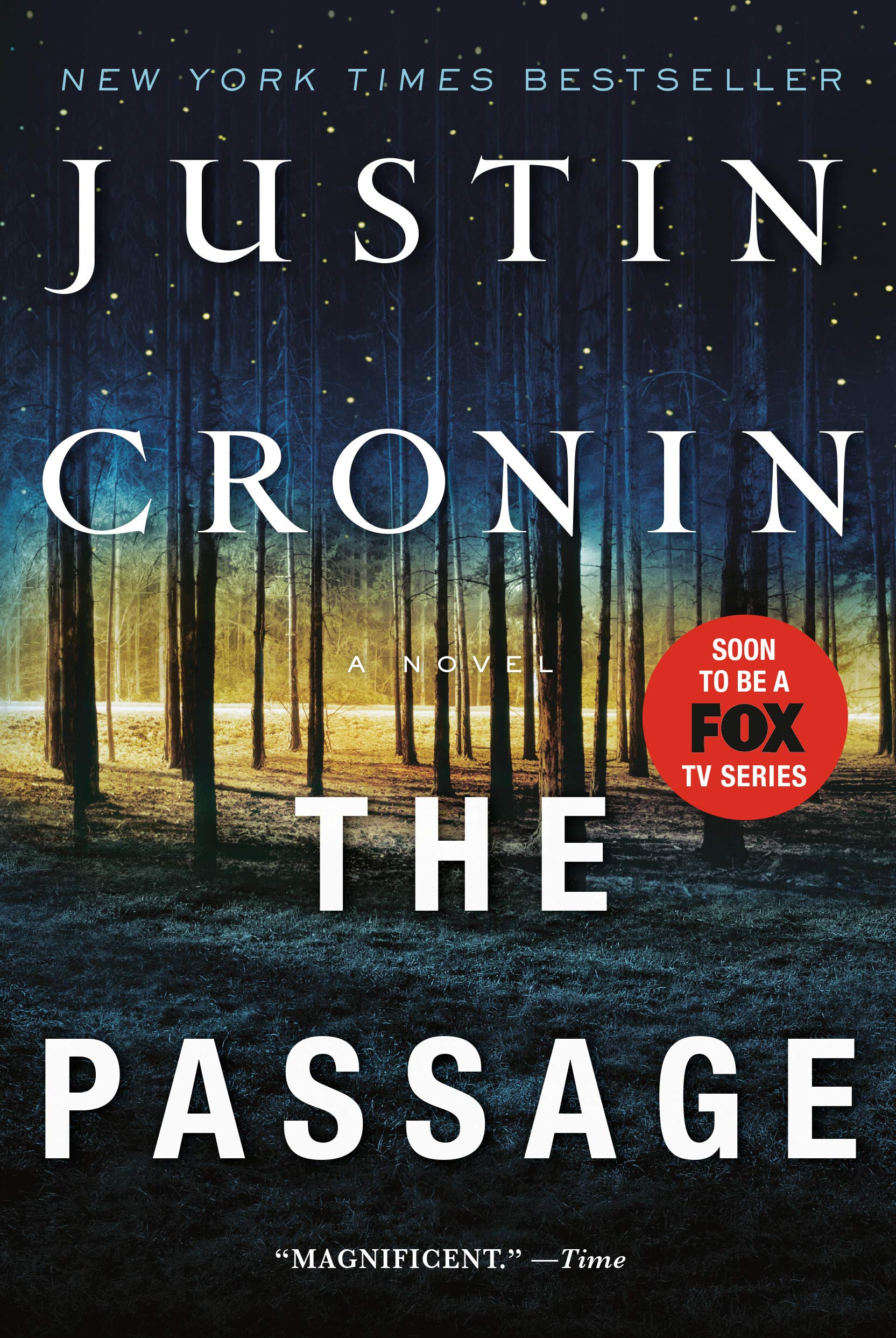
But it gives us a chance to check out the almost always superior book version, if there is one. So when another great show, "The Passage" got canceled, we just transitioned over to the Justin Cronin novel it was based on, which is even better than the show--if you have the time.

Oh, yeah. The time. Looking for a read to take you into retirement? Have some vacation time coming? Planning to cut all electronic entertainment, or possibly set a world record for sitting alone on a couch?

Then try The Passage. But if you get the print version, you might want to work out first so you can hold it up while you turn the pages.

https://images-na.ssl-images-amazon.com/images/I/91ZzQonGkvL.jpg
What would you expect? They canceled Firefly, too.


785 pages. The Passage, in fact, is three times longer than my first published novel--and it's only the first in a trilogy. You can check it out here:

https://www.amazon.com/dp/B003TJA8Y2

So how can I ask you, the people with so little time and so much to do, to tackle a book so long it could be titled War and Peace and More War?

With great enthusiasm.

What's The Passage about? Whew. Okay, here we go.

Government Agent Brad Wolgast is on a mission to collect death row inmates, who are being sent to a shadowy Federal base--what for, he doesn't know. But when he's told to pick up Amy, a recently abandoned six year old, Wolgast--whose own daughter died young--rebels. He soon discovers the experiments being done on Amy and the inmates could bring huge benefits for humanity ... or destroy civilization.

Yeah, that's just the first quarter of the book. The story's really about Amy, who may be the only person who can save the world, and then a group of survivors who find the effects of the experiments may--or may not--have left them the last people on Earth.

Then it gets complicated.

I can't say much more about the plot, because, as my wife and I kept saying as we read it, "S**t is going DOWN". Stephen King called The Passage "Enthralling", and I think that might be the best description. I read it during our staycation, and finished the whole thing in seventeen days, which can be compared to eating all the chocolate in Willy Wonka's factory in two hours. I lost sleep, I ate during meals--at one point I'm pretty sure I ate a napkin. I kept switching between my Kindle and my phone so I could go on reading whenever I had a few minutes.

Cronin fits in a lot of description, and yet I hardly noticed. His writing at times was nerve wracking, as his characters race toward disaster--or, occasionally, disaster races toward them. As a reader who reserves five stars for only the very best of writing, I wish I could add a sixth for The Passage.

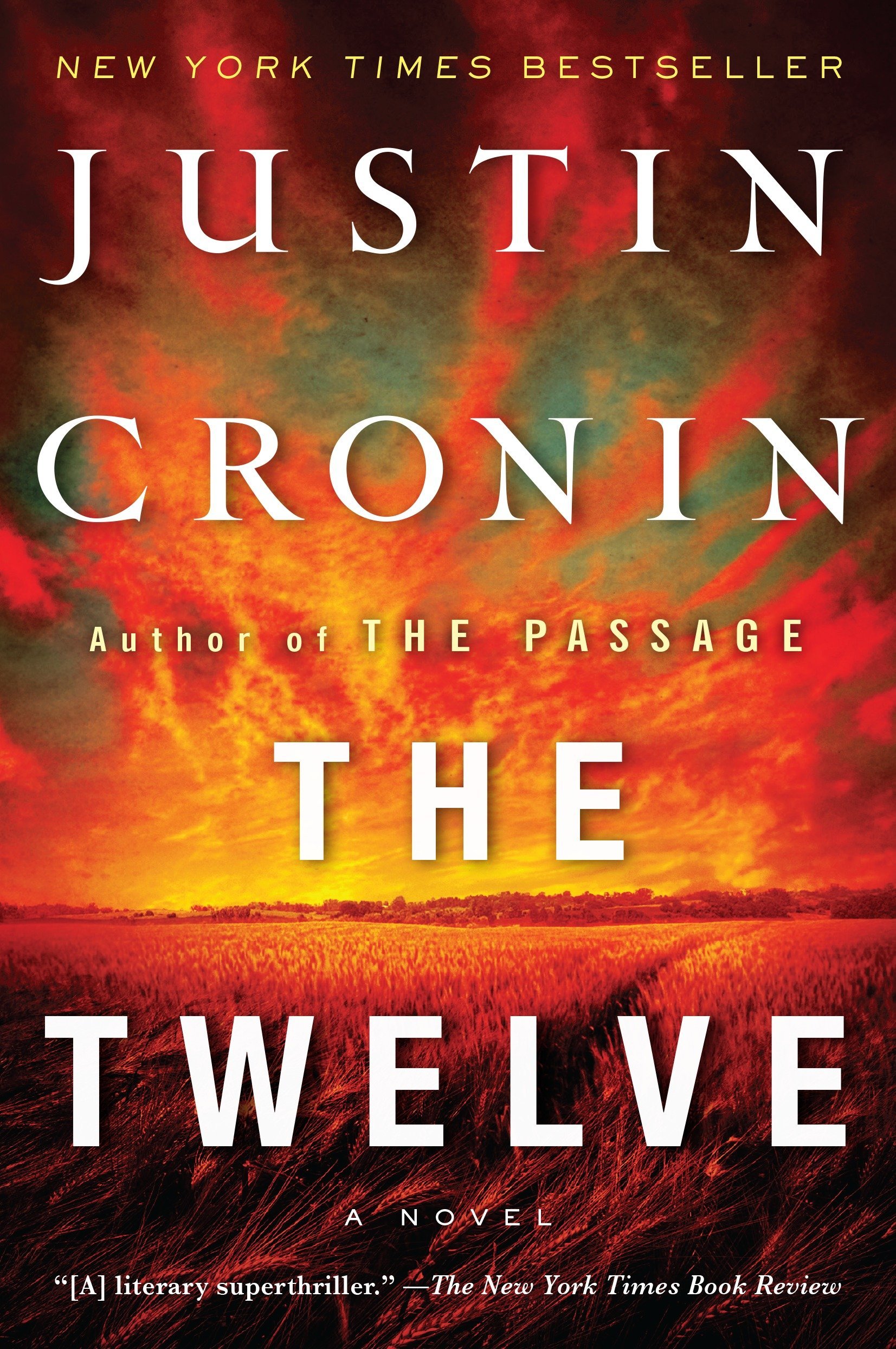
But I might need a rest before I tackle book 2.

https://images-na.ssl-images-amazon.com/images/I/91jUhOrKQEL.jpg
Next.
This seems to have unintentionally become short story month on my blog, which is ironic considering how very long April has been this year. What the heck: Here's the full story of the magazine publication I mentioned earlier, and why it's a big deal for me.
------------------------------------------------------------------------

To understand how big a deal this is, you have to understand I've been writing short stories since I was eleven years old. Maybe ten. Maybe twelve, who knows?

I can't show you those stories, to demonstrate how good they were. Even if they still existed I couldn't, because--well--they weren't good. But I got started early, and all through middle and high school I wrote short stories (instead of studying), along with the occasional novel draft (which were also bad).

I wasn't yet eighteen when I started submitting them to science fiction magazines. (At the time all my short stories were SF, while my longer works were split between SF and firefighting adventures.) My submissions had one thing in common with my stories: They were bad.

But they got better. That's what it's all about.

As time went by I took three correspondence courses on writing, and filled a bookshelf full of volumes on writing, and read huge amounts of fiction, and got better. My aim: Isaac Asimov's Science Fiction Magazine, the cream of the crop as far as I was concerned. It's still around, now called Asmov's Science Fiction:

https://www.asimovs.com/

And its editors still reject me, from time to time. It's nice to have traditions.

Meanwhile, when my first novel was published, I told the publisher that I'd written some related short stories I wanted to give away, to promote the book. They said, "Sure--just send them all in, we'll publish them together!"

I said, "Huh?"

So I wrote even more short stories to fill it out, put them all in one manuscript, and they published it as Storm Chaser Shorts, a title I'm afraid I have to take the blame for. They're pretty good, if I do say so myself ... but they weren't magazine publication.


Meanwhile, I was a humor columnist for local newspapers, and they printed some Christmas related short stories by me. Then I got some stories printed in anthologies, which was great. But, doggone it, I wanted that first magazine credit! By now it had become a forty-five year obsession. I'd been collecting rejection letters in a box, until they went digital and I collected them in an e-mail box. Sometimes I'd get encouraging personal rejections, which in this industry is so close to in, but they were still rejections.

Then, one day, an e-mail came back that said, "Readable story." It seemed like the beginning of another "pretty good but" rejection, but it was just understatement.

My trials and tribulations weren't quite over, because the magazine's publisher had an illness and death in the family. I was accepted in September of last year, and it wasn't until the March issue of this year that "Grocery Purgatory" hit the cover of "The Fifth Di ..." I either missed it or it actually came out late, because I was surprised with a contributor's copy in April.


https://www.bookdepository.com/Fifth-Di-Tyree-Campbell/9781087870267?ref=grid-view&qid=1587112259481

And there it is, at 98 pages a magazine so thick it's almost a book, for just ten bucks and change. You want to do me a favor? You do? I thought so. Order you and your family a copy, tell all your friends, and get the word around. Why? Because I want to get published in more magazines. Maybe even, someday, Asimov's.

And even after throwing away the bad ones, I still have stories to submit ... and even more to write.


After mulling it over in my mind for some time, I wrote a short story the other day, then revised and polished it. I was really proud--it was one of my better short stories, clever and fun. I was so sure of its quality that after giving it another go-through I sent it to my favorite SF periodical, Asimov's Science Fiction, at about 5 a.m. the next morning.

At about 5 p.m. I checked my e-mail, and found their form rejection letter. Twelve hours. That might be a new record response for any submission I've made.

Hey, one of the things we writers complain about is how long it takes publishers to get back to us! Besides, we need moments like that to keep from getting too full of ourselves.
 
Anyway, on with the show as we look at a Kansas literary agency I should probably submit to:


https://annettesnyder.blogspot.com/2020/04/metamorphosis-literary-agency-of-olathe.html Our mission is to help authors become traditionally published. We represent well-crafted commercial fiction and nonfiction. Metamorphosi...

Military pilot True Brighton was forced out of her job when robotic flying machines made human pilots obsolete. Now she's a member of Requisite Operations, a private military company; as The Last Good man opens, her team is plotting an operation to rescue hostages in the lawless Mideast.

But during the operation, True learns one of the terrorists may have a connection to her son--who was tortured and murdered for all the world to see, after a failed military operation several years before.

Linda Nagata is one of the masters of near-future science fiction, and in The Last Good Man she shows us a world so close to ours that in a few more years it might not be fiction at all. Dominated by robotics, paranoia becomes real when flying machines or spies the size of bugs can be watching your every move. It's the future of war, and the warriors are beginning to wonder if their future is to be overwhelmed by mechanized weapons.

The Last Good Man starts slowly, as the characters meticulously plan out their opening operation. In that way it's much like a John Grisham or Michael Crichton novel, rich in details that set your firmly into the story's universe. Some readers might not like that, and the first few chapters did drag a little, a few times. But no detail is unimportant, and once the mission starts the book barrels forward like a runaway train.

True Brighton makes discoveries that bring the horror of her son's death back to her, and soon she finds herself at odds with her own team and family, as she investigates a crime that might be much more than anyone thought. All the time she navigates through a paranoid world of constant surveillance, from machines that were once in the roll of spies, but are being weaponized--sometimes without human supervision.

In the end it's a complex and powerful tale. Why Linda Nagata (who was my instructor in a science fiction writing course, back when that stuff was done by U.S. Mail) isn't a bigger name in the writing world is beyond me.

ozma914: Haunted Noble County Indiana (Storm Chaser Shorts)
( Sep. 6th, 2019 06:25 pm)

I didn't cheer. I didn't run through the streets, kissing perfect strangers. I just kind of sat there slack-jawed, staring at the e-mail. My wife probably thought I'd gotten a death notification.

But no: I'd sold a short story. And yes, I was happy--just having trouble believing it.

To understand why one sale should shock me so, we have to go into history. Don't worry, it won't hurt.

Shortly after turning 18, I started submitting short stories. At first, they went one by one to Isaac Asimov's Science Fiction Magazine, which these days is called Asimov's Science Fiction. There were and are plenty of other magazines that print (or post online, these days) short stories, but Asimov's was the first one I read, and I was stuck on appearing there first. Just so you know, that's a stupid way to do it, then and now.

I wrote dozens and dozens of short stories. I took a course on writing them; bought dozens of books about writing; and I read hundreds of the short stories of others. I also got smart enough to send each story to every market I could find.

By the way, thanks to Linda Nagata, my teacher in that correspondence course. It was in the snail mail days. The story she helped me improve was "Grocery Purgatory", a tale of disappearances set in a small town grocery store. Read all about her here: https://mythicisland.com/

None were ever published. I came close later on, with favorable and personal rejection letters. Eventually I discarded the ones clearly written in desperation--some of them were real stinkers--while revising and improving the ones that showed promise. But no final sale.

Here's the thing: short stories of mine have been published. Some were holiday themed tales, part of Christmas inserts in the three weekly papers that published my humor column. They were not in the habit of publishing fiction, and if I hadn't already been on the staff it wouldn't have happened ... so they didn't really count.

In 2011 my first novel, Storm Chaser, came out. I wrote several short stories featuring the characters from the book, intending to give them away to promote the book itself. But when I told my publisher about it, they suggested selling them together, as a collection. That's how Storm Chaser Shorts came about: They're published, and they're short stories, but it seemed to me again that I had a bit of an unfair advantage, compared to cold selling a single story to a publisher who didn't know me. 


Three anthologies carry my stories, but they were by invite, and I think they also don't count. 

The point is, it had become personal.

(Oh, and as usual, all those can be found on our website and here, on Amazon:  https://www.amazon.com/Mark-R-Hunter/e/B0058CL6OO.) Always be closing.

As time went by, I boiled down the publishable stories to six, always waiting there in my master submission log. I had submitted my first short story in the summer of 1980.

So you see, when I received an e-mail from Alban Lake Publishing, telling me they were buying a story for one of their periodicals, I had been trying to sell to a magazine for thirty-nine years.

The story is "Coming Attractions", the bones of which I first wrote three decades ago. Revised many times and workshopped with Linda Nagata, it's hardly recognizable from the original (which was twice as long).

I'll give out more information when I get it, but my new publisher's website is here:

https://albanlakepublishing.com/ 

After almost four decades, I'll have a short story published in a magazine. Well, e-magazine. Let's just say periodical. After a summer of everything breaking and a long week of sinus infection, this small step is very good news, indeed. 

Now: On to selling the rest of them! 


http://markrhunter.com/


Book Review

Rendezvous With Rama

by Arthur C. Clarke


Many years ago I had a bedtime ritual: Prop myself up on some pillows and read a chapter or two of a book, while eating a Nutty Bar. Don't judge me, Nutty Bars are yummy. One particular evening I started a ten year old novel by Arthur C. Clarke, for a little reading time before sleep.

Only I didn't sleep much that night. I finished the book in the wee hours of the next morning.

Still, sometimes things aren't as good as you remembered, so thirty years later I once again picked up Rendezvous With Rama, this time with some trepidation. Would it hold up to my memories?

It did. Although this time it took me a few days to read, what with adult responsibilities and all.

Rendezvous With Rama begins when astronomers discover an asteroid that turns out to be from outside the solar system; it's roughly cylindrical, spinning, and moving at a pretty good clip as it prepares to pass closer to our Sun than the orbit of Mercury. You'd be forgiving for having a sense of deja vus at this point, since in 2017 astronomers, for the first time, discovered an asteroid coming in from outside our solar system ... roughly cylindrical, spinning erratically, and passing closer to our Sun than the orbit of Mercury:

https://www.theverge.com/2017/12/18/16788354/oumuamua-interstellar-asteroid-outer-layer-ice-interior-comet

Arthur C. Clarke was always a bit ahead of the game.

This is the edition I have now--a book club version with a nifty pullout illustration.


Unlike the real version, the book's asteroid turns out to be anything but: It's an artificial construction thirty miles long, moving so quickly that only one spaceship is in a position to intercept it. Having been on the move for possibly hundreds of thousands of years, the massive ship is dead and silent, but there still might be secrets to uncover inside.

When the crew of the survey vessel Endeavour manages to get inside the newly named Rama, they find a dark, cold, and dead world. But they also find a breathable atmosphere, a frozen sea, and incredible architecture held to the inside surface by the spinning craft's centrifugal force.

Then the lights come on ... and it turns out Rama isn't quite as dead as anyone imagined.

Did I mention the nifty pullout illustration?

 Here's the thing about Rendezvous With Rama: If a new writer submitted that novel to a publisher today, it would probably be rejected. It has little conflict between the characters, who tend to be rather two dimensional. It flows more like a series of wonders than a plot, in a way that reminds me of Jules Verne's 20,000 Leagues Under the Sea. There aren't really any bad guys here, except in one case in which a certain group of peoples' motives were, to me, a little shaky. Several scenes are set in a meeting where the members spend most of their time just speculating on what's going on.

So why is it still a page turner? Nobody could put the science in science fiction like Clarke. He manages to describe complicated landscapes and concepts in a way that's interesting, but still keeps the story cooking along at a good pace. He's one of those writers who can make exposition fascinating.

That's not to say there's not plenty of action too, as the human crew makes its way into the unknown, and encounters things that may, or may not, be out to get rid of intruders. The explorers encounter challenges and surprises galore, and Clarke does his usual great job of making an incredible thing both credible and scientifically accurate. It's as much a page turner today as it was the first time I read it, and holds up perfectly. It would make a great movie in the right hands (and a really stinky one in the wrong hands).

Also, it has one of the great twist closing lines in all of literature.


Doctor Who fans are aghast, or deliriously happy, that the show's main character is having a sex change. Non Doctor Who fans are saying the same thing they always say when they hear details about the show: "Huh?"

We'll get to the good Doctor--whose name is not Who--in a moment. This is set against the bigger question of whether it's okay to change the race or gender of an established character, always (so far) to a person of color and/or womanliness. In general, if it's another case of political correctness gone rampant (I call it Political Over-Correctness) I'm not a fan.

"The next James Bond needs to be black!"
"Why?"
"So we can have a black James Bond!"
"Okay. Or, you could just create a black secret agent from scratch."
"Yeah, but ... then he wouldn't be James Bond!"

Honestly, it's not something I care enough about to argue over, which sets me apart from most people who care at all. If the TV and movie industry disappeared from the face of the earth right now--which isn't the worst idea ever--I'd just go back to reading books for entertainment. Interestingly, if the race of a character in a book isn't specifically mentioned, most people either don't think about it at all or put their own skin color on the character. It never occurred to me, until I saw the wildly entertaining TV version, that Shadow Moon from American Gods was black. You can call that racism or you can call it being color blind, whatever. People will color anything I say here with their own views anyway.

James Bond is an interesting case when it comes to gender and race swapping, because the franchise has already done it--just not with 007. Bond's CIA buddy Felix Leiter has already turned from white to black--twice, if you include 1983's Never Say Never Again. The famous Moneypenny had a similar transformation, while Bond's boss M became a female ... although it should be noted that M is a title, rather than an individual.

You can complain about it all you want, but for me when it does work, it works spectacularly. Starbuck from Battlestar Galactica was just as much fun and kick-ass as a woman in the reboot, for instance. From the time I was old enough to read comics I knew Nick Fury as a white guy, fighting his way across Europe in World War II. Now I can't imagine him looking like anyone but Samuel L. Jackson.

Which brings us back to Doctor Who, who Samuel L. Jackson could totally play if he wanted to. Are you going to tell him no?

On the question of changing a character's looks just for the sake of changing them, the Doctor is a special case. Sometimes the actor playing a character is changed without explanation, as with the James Bond series. (Wait--who's this new Darrin on Bewitched?) Sometimes it's a reboot, as with Battlestar Galactica, and thus not really the same character. But Doctor Who ...

Okay, in case you don't know, I'd better offer a brief explanation.

The original Doctor Who, back in 1963, was an old guy. He was a grandfatherly type, on a show designed as a fun way to teach kids history. (He's a Time Lord, you see.) But the actor began to have health problems, and it was soon apparent he couldn't continue in the roll. It seemed Doctor Who was doomed to retirement.

But wait, the writers said. We've already established that he's an alien. Suppose this particular species of aliens, when facing death, could cheat their way out by transforming into a new body? Regenerate into, say ... another actor's body?

Yeah, they're all the Doctor


That was twelve Doctor's ago. More, really, but we don't have time to go into that complication. In fact, the Doctor has already been a woman, played (very briefly) by Joanna Lumley in a 1999 charity episode.

So there's no story reason why the Doctor can't be female. In fact, one of his main antagonists, also a Time Lord, already regenerated from male to female. The show has had many strong female and minority characters in the past, and the Doctor's most recent companion was a black lesbian. (Is lesbian still a permitted word? I don't care.)

That's Bill, on the left. Black, prefers women, young, smart, and most importantly fun.
So that's where we are in the Doctor's complicated half century. In the Christmas episode the current Doctor is going to meet the first Doctor--that kind of thing happens, from time to time--and then presumably regenerate into someone who looks a lot like the actress Jodie Whittaker. If they did it to freshen up the show and keep things interesting ... well, why not? I'm not sure it's any more of a shock to me than when uber-young looking Matt Smith regenerated into still another grandfatherly type.

I wasn't thrilled back then ("my" Doctor is David Tennant), but I came to like Peter Capaldi's version. That's why I don't understand the so-called fans who are closing the doors of the TARDIS and going home. I know it's not just mysogeny, as some narrow minded people claim. Not always, anyway.

Honestly, I suspect it's just resistance to change in general, and I get that. Contrary to what some will tell you, sometimes change is bad. But you won't even give the new Doctor a chance? Why not? With that attitude, the show would never have made it out of the sixties.

And we'd have missed a lot of fun.

There's a new Doctor in the TARDIS
If you’ve gone to the movies this century, you know that you never, never say yes to a mission on a remote island, especially if you’re going with a mix of scientists and soldiers.
 
But in 1973 nobody knew that, at least not if they didn’t watch Godzilla movies, so Samuel L. Jackson can be forgiven if it takes half of Kong: Skull Island before he says “I’m getting’ sick and tired of these mother frakking monkeys on this mother frakking island!” (Kidding. But if he did say that, I’d be paraphrasing.)
 
Jackson is Colonel Packard, who commands the military part of the expedition, and for him it’s perfect timing: the Vietnam War has just ended, leaving Packard out of sorts and looking for a fight he’ll be allowed to win. He doesn’t hesitate to join up with a British survival guide (Tom Hiddleston), a war photographer (Brie Larson), and members of the mysterious Project Monarch, including Bill Randa (John Goodman), who knows more than he’s letting on about a strange island surrounded by perpetual storms.
 
Spoiler alert: There’s a giant ape stomping around on the island.


In fairly short order the humans manage to piss off the ape, who in even shorter order makes (sometimes literally) mincemeat out of them. The saner characters want to get the heck out, but Packard has lost men and goes full on Captain Ahab with this hairy Moby Dick. This even after a stranded World War II airman (John C. Reilly) tries to explain Kong is protecting a tribe on the island—and maybe all humanity—from even more violent beasts, which we learn are called Massive Unidentified Terrestrial Organisms.
 
By this time many moviegoers are scratching their heads over a strange feeling of deja vus. “Wait—haven’t we heard of M.U.T.O. and Project Monarch before?
 
Yes, we have: In 2014’s Godzilla, which is why monster movie buffs are in such a tizzy. One of the first movies I remember was Godzilla vs. King Kong, which was released the year I was born (ahem--I saw it later), and now we’re being set up for a rematch.


But back to Kong: Skull Island, which stands up very well on its own, thank you. The cast is first rate, and you’d be hard pressed to tell where the digital effects began, although I’m betting they didn’t have a hundred foot tall animatronic ape on set. The movie was filmed around the world, and some of the scenery is breathtaking, as are the action sequences. Oh, and there’s also a plot, which in general amounts to “How do we get off this island?” and “which monster’s side are we on?” The characters face the possibility that killing Kong might release the island’s other monsters onto the world, but that if they don’t Kong might, you know, kill them.
 
One warning: The movie’s rated PG13, but it should be R. The violence is pretty intense and sometimes graphic and, naturally, lots of people die. Also, there’s a giant spider. Eek!
 
If you’re any kind of a monster movie fan, stay for the post-credits scene.
 
 
My rating:
 
Entertainment value: 4 M&M’s. The movie was so fast-paced and action-packed that even the little kid two rows back who would NOT. STOP. TALKING. didn’t ruin the experience.
 
Oscar potential: 4 M&M’s. Not for actors, cause’ hey—genre movie. But there needs to be some Academy love for effects, cinematography … I don’t know … Kong’s makeup?
 Here's what writers do with dreams:
 
The other night I had a dream that my home town was populated by the characters from "The Andy Griffith Show". Opie, the boy from the show, was a teenager, and was preparing to go to the prom; but his date was very sickly looking and had lost all her hair, and everyone was concerned that if she died, Opie's heart would be broken.
 
(We've been dealing a lot with cancer involving friends and family the last few years.)
 
On the drive to Emily's work the next day, I outlined the dream (I was in it, but mostly as an observer). It's not unheard of for me to use elements of dreams in my fiction, but I told her I didn't see any way I could turn this scenario into the kind of stories I write.
 
Then we started talking about it.
 
It's an hour long trip. I dropped her off, then started writing down the ideas ... By the time I was done, I had a sloppy thousand word synopsis and some short character sketches. There is now no sign whatsoever of the "Andy Griffith Show" characters--all I have is the prom scenario, a sickly girl, a sensitive, loner teenage nerd, and a small town. Just the same, I gave tribute to the original dream in my working title:
 
"Mayberry UFO."
 
A UFO does not actually appear in my story idea, but my mind works in strange ways. For now, I've added this to my list of 50 or so "to be written" stories.

I had a dream this morning (possibly fueled by pain medication) that led me to an idea for a novel, kind of a science fiction mix of Lord of the Flies and the TV show Lost. Then I realized it could be turned into a book series. 

That would be about the thirtieth idea I’ve had for stories that could be turned into a series. Even if I won the lottery and started writing 80 hours a week right now, I’d die of old age before I could get to book 2 of most of them. 

Not that I wouldn’t mind trying.


We saw a movie in 3-D today, by accident.

I can take or leave 3-D, and since it costs more I usually leave it. But we’d misread the schedule, and rather than wait around another half hour we chose to watch Ant-Man in three dimensions. It was in a theater which just replaced its seats with power recliners, which makes it a far cry from the movie-going experiences of my youth. I can take or leave the recliners, too. It’s nice to not worry about a tall guy sitting in front of you, though.

Happily, in this case the movie uses 3-D without relying on it. Sometimes moviemakers overthink the format, throwing everything from arrows to crashing vehicles at the viewer in the hopes of setting a new audience jump record. I wonder if the same thing happened with the first talkies, or the color films? Probably early movies in those formats threw their newfangled tricks at viewers, just as the early 3-D movies did.

But the day will come when 3-D will be just another part of every movie experience, regardless of how much some hate it now. Having things jump off the screen at you will be no more remarkable than hearing Johnny Depp’s newest accent, or seeing the primary colors of a superhero’s costume. I’ll probably choose 2-D for some time to come … just as people chose the less garish black and white movies decades ago. But I can go either way.

As for the movie itself? Ant-Man was great fun, and I highly recommend it in the dimension of your choice.


.

Syndicate

RSS Atom

Most Popular Tags

Powered by Dreamwidth Studios

Style Credit

Expand Cut Tags

No cut tags